
Seeing may feel automatic, but vision is far more than light entering the eyes. What we actually experience as sight is the result of a complex and carefully coordinated system known as the visual perception process. This process allows the brain to receive visual information, organize it, and interpret meaning from the world around us.
Understanding how visual perception works helps explain how we recognize faces, judge distance, detect motion, and navigate daily life safely. It also highlights why some visual problems are not caused by the eyes alone, but by how the brain processes visual input.
The Visual Perception Process: Step by Step
The process of visual perception happens in stages. Each stage builds on the one before it.
Step 1: Reception – The Biological Input
The process begins when light enters the eye.
Light is first focused as it passes through the cornea, then moves through the pupil, which adjusts in size through dilation and constriction to control light intensity. The crystalline lens further refines focus through a process called accommodation, allowing objects at different distances to appear clear.
The light then travels through the aqueous humor and vitreous body before forming an image on the retina. This retinal projection sets the foundation for all visual processing.
At this stage, vision is still purely physical. No interpretation has happened yet.
Step 2: Transduction – Converting Light Into Neural Signals
Once light reaches the retina, it must be translated into a form the brain can understand.
This conversion process is called phototransduction. Specialized cells known as photoreceptors carry out this task. Rods respond to low light and movement, while cones handle color vision and fine detail.
When light strikes these cells, visual pigments such as rhodopsin and photopsins react, triggering chemical signaling and neural firing. This includes changes in light sensitivity, pigment bleaching, and dark adaptation. Vitamin A plays an important role in maintaining this system.
At the end of this step, light energy has become electrical signals.
Step 3: Transmission – The Neural Highway to the Brain
The electrical signals generated in the retina must now travel to the brain.
They move through the optic nerve, cross partially at the optic chiasm, and continue along the optic tract. This crossing allows each side of the brain to receive information from both eyes.
Before reaching the visual cortex, signals pass through the lateral geniculate nucleus (LGN) within the thalamus. Here, visual data is filtered, organized, and prepared for higher processing. This step helps reduce noise and prioritize important visual input.
Step 4: Selection and Organization – Primary Visual Processing
The next stage occurs in the visual cortex, located in the occipital lobe at the back of the brain.
The primary visual cortex, often called V1 or the striate cortex, begins feature detection. This includes identifying edges, orientation, color, contrast, and motion.
From here, information follows two major processing pathways:
- The dorsal stream, often described as the “where” or “how” pathway, helps with spatial location, movement, and coordination.
- The ventral stream, known as the “what” pathway, supports object recognition, facial identification, and color meaning.
This division allows the brain to understand both where objects are and what they are.
Step 5: Interpretation – The Psychological Output
The final stage of the visual perception process is interpretation.
Here, the brain uses visual memory, experience, and context clues to assign meaning. This involves both bottom-up processing, which relies on sensory data, and top-down processing, which draws from past knowledge and expectations.
The brain also applies Gestalt principles, such as figure-ground separation, proximity, similarity, and pattern completion. These rules allow the brain to organize complex scenes quickly and efficiently.
This stage explains why two people can see the same image but interpret it differently.
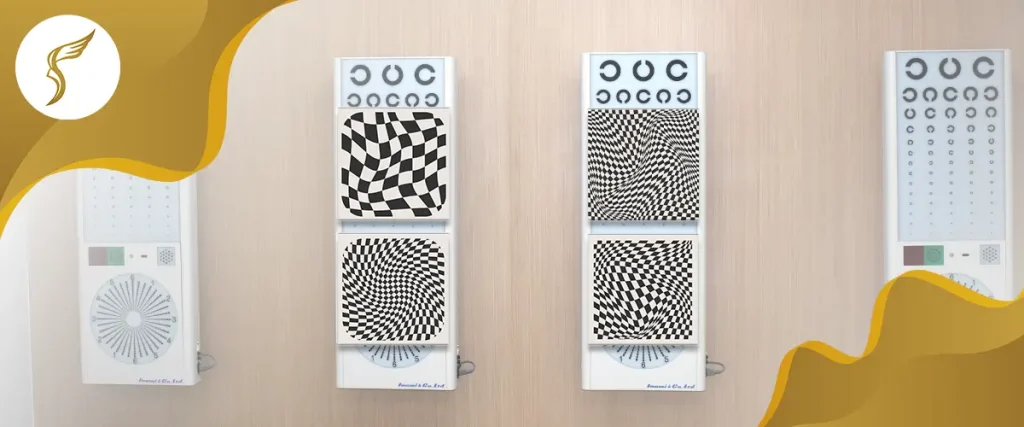
Optical Illusions and Visual Perception
Optical illusions demonstrate how visual perception is not always perfect. They occur when the brain relies on shortcuts, known as perceptual heuristics, to interpret information quickly.
These illusions reveal the powerful influence of context, expectation, and prior experience on what we believe we see.
Visual Perception Across the Lifespan
Visual perception develops over time. In infants and children, visual processing systems mature gradually as the brain learns to interpret visual input more efficiently.
In adulthood, perception is usually stable, though factors such as fatigue, lighting conditions, and attention can influence visual clarity. With aging, some aspects like contrast sensitivity and processing speed may change, making good eye care even more important.

When Visual Perception Is Affected
Visual perception difficulties may appear even when eyesight is clear.
Common signs include:
Difficulty judging distance or depth
Trouble reading despite normal vision
Poor hand-eye coordination
Feeling overwhelmed in visually busy environments
These issues may be linked to how the brain processes visual information rather than to eye health alone.
Frequently Asked Questions (People Also Ask)
They include reception, transduction, transmission, organization, and interpretation.
It primarily occurs in the visual cortex and connected brain pathways.
Sensation detects light, while perception interprets meaning.
Yes. The eyes may be healthy, but the brain’s processing may be affected.
Final Thoughts
The visual perception process shows that seeing is a partnership between the eyes and the brain. Each step—from light capture to interpretation—plays a critical role in how we understand the world.

Claim Your Exclusive LASIK Offer
By submitting this form, you consent to the processing of your personal data in accordance with our Data Privacy Notice.
At Shinagawa Lasik & Aesthetics, patient education is an essential part of eye care. By helping people understand how vision truly works, Shinagawa continues to support informed decisions, better eye health, and clearer vision for every stage of life.
For inquiries, questions, and appointments, call our Patient Care Lines:
🖥 Talk to our Consultants via Livechat: https://direct.lc.chat/6329011/
📱 Instagram: https://instagram.com/shinagawa_ph/
Citations and Resources
Shinagawa LASIK & Aesthetics strives to provide accurate and reliable information regarding LASIK procedures and eye health. We utilize primary sources to support our content, including peer-reviewed scientific studies, data from reputable medical organizations, and expert opinions. We also reference established publications and research where appropriate.
Our commitment to evidence-based information ensures that you receive trustworthy and up-to-date details to make informed decisions about your eye care.
Resources Used in This Article
- Cullen College of Engineering. “Professor Publishes Third Book Surrounding Visual Perception, https://www.egr.uh.edu/news/200802/professor-publishes-third-book-surrounding-visual-perception”
- PubMed Central. “Learning what to expect (in visual perception), https://pmc.ncbi.nlm.nih.gov/articles/PMC3807544/”
- Taylor and Francis. “Top-down and bottom-up effects on visual perception during data-based scientific reasoning in the context of population dynamics, https://www.tandfonline.com/doi/full/10.1080/09500693.2024.2419986″