
Ocular hypertension is a condition that often goes unnoticed because it usually has no symptoms. Many Filipinos only hear about it when they undergo a routine eye exam and learn that their intraocular pressure (IOP) is higher than the normal range of 10–21 mmHg. While ocular hypertension is not the same as glaucoma, it is considered a risk factor and a possible early warning sign. When unmanaged, it may increase the likelihood of optic nerve damage and future vision loss.
Understanding ocular hypertension, how it affects your vision, and how it can be managed is an important step in protecting your long-term eye health.
What Is Ocular Hypertension?
Ocular hypertension happens when the pressure inside the eye is elevated but the eye itself remains healthy.
This means there is:
- High intraocular pressure,
- No optic nerve damage, and
- No visual field loss.
It is different from glaucoma, where the high pressure has already caused damage to the optic nerve head (ONH) or has affected a person’s side vision. It also differs from normal-tension glaucoma, a condition where damage happens even if the pressure is within the “normal” range.
For many people, ocular hypertension is a borderline or asymptomatic condition, which makes regular eye check-ups especially important.
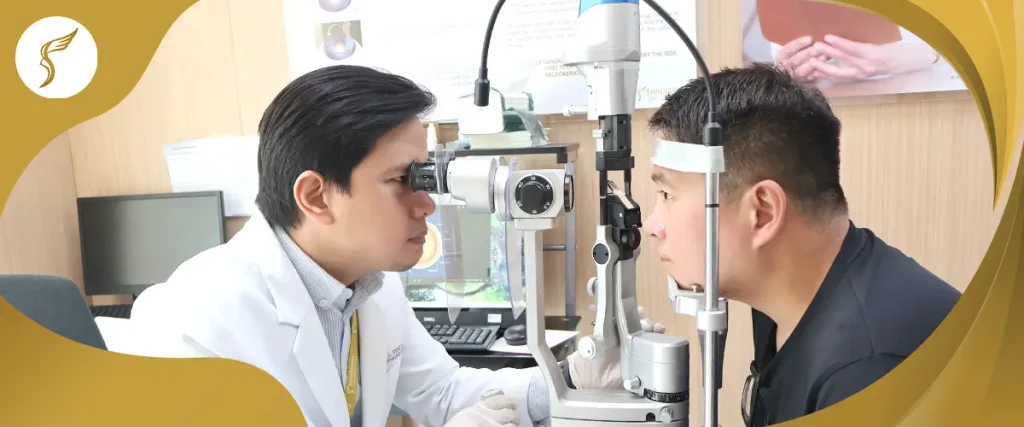
How Ocular Hypertension Affects Your Vision
Most people with ocular hypertension still see normally. The condition is often discovered only through an eye exam. This is because elevated eye pressure does not immediately affect vision.
However, if the pressure stays high over time, it may increase the risk of developing glaucoma, a disease that causes gradual loss of peripheral or side vision. Without treatment, this damage can progress to “tunnel vision.
A landmark study, the Ocular Hypertension Treatment Study (OHTS), found that people with untreated ocular hypertension have a significantly higher chance of developing glaucoma later in life. The study also showed that early treatment can cut this risk by more than half.
Why Ocular Hypertension Happens
Ocular hypertension can occur when:
- The eye produces too much aqueous humor (the fluid inside the eye), or
- The fluid does not drain properly through the trabecular meshwork.
It may also be linked to other conditions, such as:
- Long-term use of steroid medications
- Eye injury
- Prior eye surgery
- Inflammation
- Pigment dispersion or other ocular conditions
Systemic factors like age, family history of glaucoma, diabetes, and high myopia may also increase the risk of developing high eye pressure.

Who Is at Higher Risk of Developing Glaucoma From Ocular Hypertension?
Not everyone with ocular hypertension will develop glaucoma. But certain factors increase the chance of conversion:
- Age 40 and above
- Thin central corneal thickness (CCT)
- Large cup-to-disc ratio
- Family history of glaucoma
- African or Asian descent
- Diabetes and high myopia
In the Philippines, where many adults delay regular eye checkups, ocular hypertension can go undetected for years—making it more important to seek preventive eye care.
How Ocular Hypertension Is Managed
Management depends on your risk of future glaucoma.
Observation / Monitoring
If the optic nerve is healthy and risk is low, doctors may recommend regular monitoring every 6–12 months. This includes repeated pressure checks, OCT scans, and visual field tests.
Pressure-Lowering Eye Drops
These medications help reduce pressure by either increasing fluid outflow or decreasing fluid production. Examples include:
- Prostaglandin analogues
- Beta-blockers
- Alpha agonists
- Carbonic anhydrase inhibitors
Conversational FAQs
Not yet. Ocular hypertension means the pressure is high, but the optic nerve is still healthy.
It usually does not disappear, but it can be safely monitored with regular check-ups.
Pressures above 21 mmHg are considered elevated, but risk depends on corneal thickness and other factors.
Not always. Treatment depends on your risk profile, which your eye doctor will evaluate.
Most patients need a check-up every 6–12 months, depending on their risk.
Conclusion
Ocular hypertension may not cause symptoms, but it is a condition that requires careful monitoring and proper management. Regular eye exams, early detection, and personalized treatment plans can significantly reduce your risk of developing glaucoma in the future.

By submitting this form, you consent to the processing of your personal data in accordance with our Data Privacy Notice.
At Shinagawa Lasik & Aesthetics, we provide comprehensive eye evaluations using advanced diagnostic tools to assess eye pressure, optic nerve health, and your overall visual well-being. With our expertise and commitment to patient care, you can take confident steps toward protecting your vision for the long term.
For inquiries, questions, and appointments, call our Patient Care Lines:
🖥 Talk to our Consultants via Livechat: https://direct.lc.chat/6329011/
📱 Instagram: https://instagram.com/shinagawa_ph/
Citations and Resources
Shinagawa LASIK & Aesthetics strives to provide accurate and reliable information regarding LASIK procedures and eye health. We utilize primary sources to support our content, including peer-reviewed scientific studies, data from reputable medical organizations, and expert opinions. We also reference established publications and research where appropriate.
Our commitment to evidence-based information ensures that you receive trustworthy and up-to-date details to make informed decisions about your eye care.
Resources Used in This Article
- Cleveland Clinic. “Ocular Hypertension, https://my.clevelandclinic.org/health/diseases/24621-ocular-hypertension”
- Yale Medicine. “Ocular Hypertension, https://www.yalemedicine.org/conditions/ocular-hypertension”
- National Library of Medicine. “Intraocular Pressure, https://www.ncbi.nlm.nih.gov/books/NBK532237/”
- Science Direct. “Risk for ocular hypertension progression to early glaucoma: A predictive model and key predictors, https://www.sciencedirect.com/science/article/pii/S1572100025001462″
- Nature. “Relationship between blood pressure and intraocular pressure in the JPHC-NEXT eye study, https://www.nature.com/articles/s41598-022-22301-1″
- American Academy of Ophthalmology. “Landmark Glaucoma Studies: Key Findings and Treatment Lessons, https://www.aao.org/eyenet/article/landmark-glaucoma-studies-key-findings-treatment-l”